

EcoVillage Moldova
Take Two

You might remember the tale of my first journey to EcoVillage Moldova in April this year. The community is only an hour’s drive from the capital city of Chișinău. When I made the trip again a couple of weeks ago, I found the garden coming along beautifully, bursting with leafy green energy. On tables in the dining room, rose petals, dill, and linden flowers were spread out to dry. The bees that had been buzzing around my first visit were quietly tucked into their hives. This time, outsized wasps had become the latest pollinators in residence. I arrived with a sense of purpose, eager to record the story of how this Earth-friendly village came to be.
The Green Agenda
EcoVillage Moldova and their partner EcoVisio are among the animators of today’s burgeoning environmental movement. On June 10, 2025, the Swedish International Development Cooperation Agency released a report on Moldova’s progress towards a green economy and European Union alignment. The report certifies significant achievements in the country’s green transformation—much more than climate action. This country’s commitment to “The Green Agenda” is playing out on many levels.
The story is about to get greener! For 6 days beginning Tuesday, June 17, Moldova hosts a very special group of fieldworkers: green journalists in the making. The select cohort from Moldova, Germany, Poland, Belarus, France, and Ukraine is taking a deep dive into sustainable development, climate change, and environmental issues during a roving 6-month green journalism program funded by the German Foreign Office.
This is an absolutely perfect moment to properly introduce the site of their first field lab: EcoVillage Moldova.
How to Seed an EcoVillage
Liliana B, Village EcoVillage Moldova co-founder and manager, shared with me a few of the milestones…
In 2012, twenty Moldovans showed up at her invitation for a cup of tea and a conversation about establishing an eco community in Moldova. The dialogue continued for a couple of years until one day in 2014, when Liliana and her husband found the land they’d been looking for. The plot they acquired was a bit smaller than they’d originally envisioned. “But we thought, ah, let's start small. And there is room to grow if things work out,” she recalled. Construction began in 2015. In the 10 years since, their green idea has become an experiential learning environment—a place where they invite others to join them in beta testing eco-sensitive designs and materials.


Eco Construction
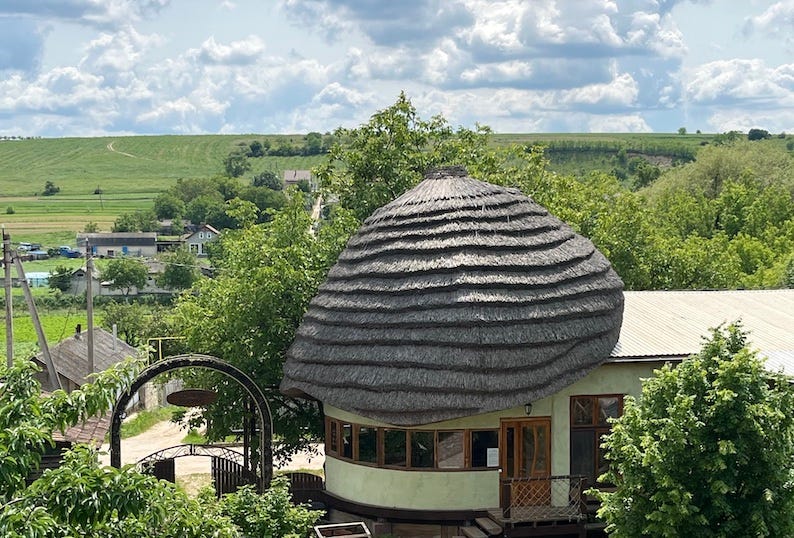
The workshop building at the entrance was the first eco construction project in the village. Known as the Mushroom House, the edifice is crowned with a towering thatched roof in the shape of a mushroom cap. The walls are made of stacked straw bales. Here and there, you can still see bits of straw peeking through the white washed clay surface. On the hot June day of our visit, the room felt cool, the air fresh. In winter, the building’s natural insulation makes it easy to keep the rooms warm. Strategically placed windows and glass blocks embedded in south-facing walls offer openings for passive solar heat.
The cost savings helped EcoVillage weather COVID, Liliana says. “One of the main sources of income is organizing events. During COVID, we couldn't do programs, but we still had to pay for electricity and gas. With reduced power costs and cash reserves, we managed to keep going.”
The Mushroom House has other histories to tell. In 2022, when Russia invaded Ukraine, the larger of its two rooms—usually a training and meeting space, became a bedroom for a Ukrainian refugee family. Liliana remembers that, at one point, EcoVillage housed 50 people a day. The second room in the workshop building became a mini kindergarten for 20 refugee children who were taught by a kindergarten teacher who was herself fleeing the war.


Eco Vibe
Here, the stage is set for learning and co-creation. EcoVillage brings visitors close to nature, designed to connect with the surrounding environment, a flourishing garden, nearby forest, fresh fare made from local ingredients, and homegrown herbal teas. The vibe is both relaxing and motivational. Programs and events offer space and time to reflect and share, with hands-on activities both inside and outside, task-based projects that generate a true sense of belonging.
Industrious Students
Earlier this year, industrious vocational school students came together for a 6-day residency. Teens from Germany joined Moldovan youth for a productive international exchange. Students from the two countries worked as a team to build solar dehydration units, flower boxes and benches for the garden, and even constructed tables with chairs for Rișcova’s community park.
Activist Adults
For adults visiting the village, programs are about growing and sustaining healthy communities, organizations, and businesses. Exploring best practices, strategic planning, resilience, collaboration, and networking is how they learn to strengthen their capacity to grow their local community. Past sessions have centered on energy efficiency and waste management or focused on team building.
Solid Partners
EcoVisio and EcoVillage Moldova are committed partners. They engage a broad community of organizations, donors, and followers in their initiatives. The two collaborated on the design and building of the EcoVillage Training Center that opened officially in 2018. Based in Chișinău, EcoVisio is community centered. Its stated mission is "Developing an ecosystem of people, initiatives and conscious practices for a healthy Moldova and a healthy Planet." In practice, this means connecting, educating, supporting and inspiring a range of individuals from Moldova and other countries through training sessions, workshops, courses, forums, fairs, study visits and internships, business incubators and accelerators.
Friends of Moldova
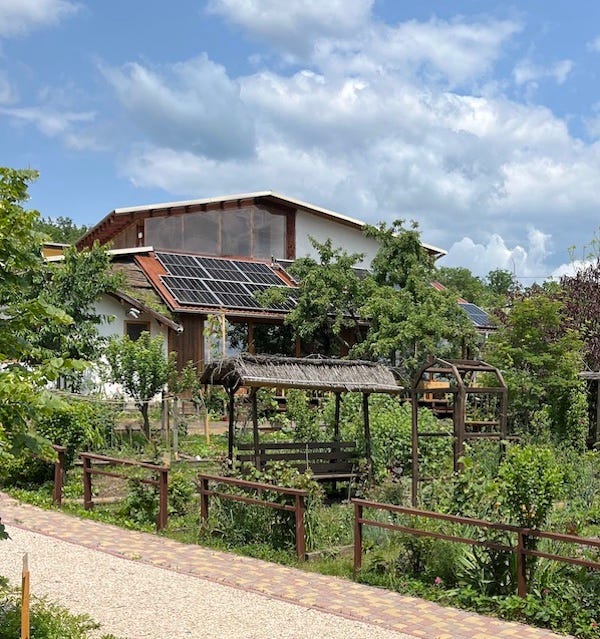
Last year, a big boost came from Dan Kane, one of the Friends of Moldova, a Facebook group started by former Peace Corps volunteers. Liliana was a program manager for Peace Corps Moldova at the time Dan had served as a volunteer here and they’d stayed friends. He left a generous donation to EcoVillage in his will, an unexpected infusion of funds that paid for the purchase and installation of solar panels and the addition of a dining room for the training center.


How The Garden Grows
We walked the garden paths, past rows of vegetables and herbs—cabbage, fennel, kale, rhubarb, and lettuce, green onions, dill, and mint. They even grow chickpeas here. Trees and bushes protect perennials like strawberries and asparagus. Layered plantings allow for bugs to multiply, for mushrooms to grow. As I stooped down to pick strawberries and reach up for cherries, I noticed how much the birds love the tree-filled garden. They’d pecked the fruit with a few kisses.
In this garden, there’s a plant rotation system. Liliana got inspired while visiting an eco village in Sweden. “I saw their spreadsheet, and thought, That makes sense. That's what we should do,” Liliana remembers. EcoVillage Moldova introduced the system in 2020, and it’s been working well. “It allows us, first of all, to do the planning in February. We have all the information in one document so we can see what grew there last year and the year before. We can write notes about the condition of the soil, what grew well, and what didn't grow. You have to make the gardening fit Moldova. See what works here.” she says.
See What Works
From the beginning, it seems, sustainability has been top of mind for EcoVillage Moldova—from building design to construction materials, from programs to services, from gardening to composting. The key is identifying accessible, affordable, and resilient resources. But figuring out the right materials, tools, and skills is only half of the equation. From what I’ve seen so far, the critical component is building a shared sense of community. You have to make it yours. You take a little bit of knowledge, gather the resources, and adapt the formula as you go. Try something. See what happens. Make mistakes. That, it seems, is what it takes to grow an EcoVillage.
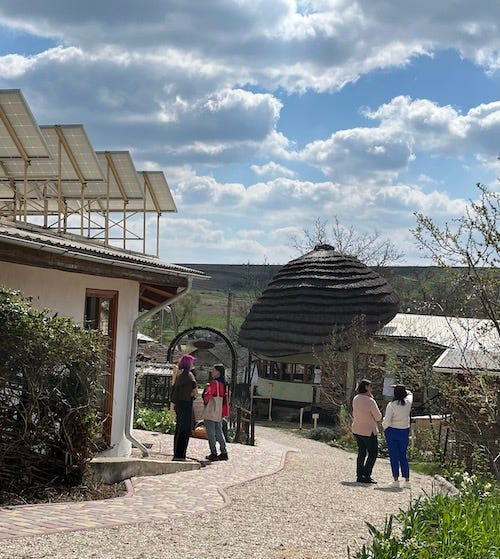
On the first day of June 2025, when I got into a micro-bus and headed for my second visit to EcoVillage, I felt like a veteran. My first journey, quite traumatic at the time, now appears a mere speck in the rearview mirror. Read the story of my first visit HERE.